Product three · live
The Booth. The whole roster, in one place.
The system an artist management company runs itself on. The roster and the people you are talking to about joining it, every agreement and the points still blocking it, the recordings that come in, the paperwork, the diary, and what each artist has actually earned.
Built for a working management company and in daily use · licensed per company · no artist ever sees it
It opens on the question you already have.
What needs somebody this morning. Most systems open on a dashboard nobody reads. The Booth opens on the things that are waiting: the clause the solicitor has not come back on, the agreement sitting unsigned, the mix that arrived overnight, the fee that changed.

Open points are the spine of it
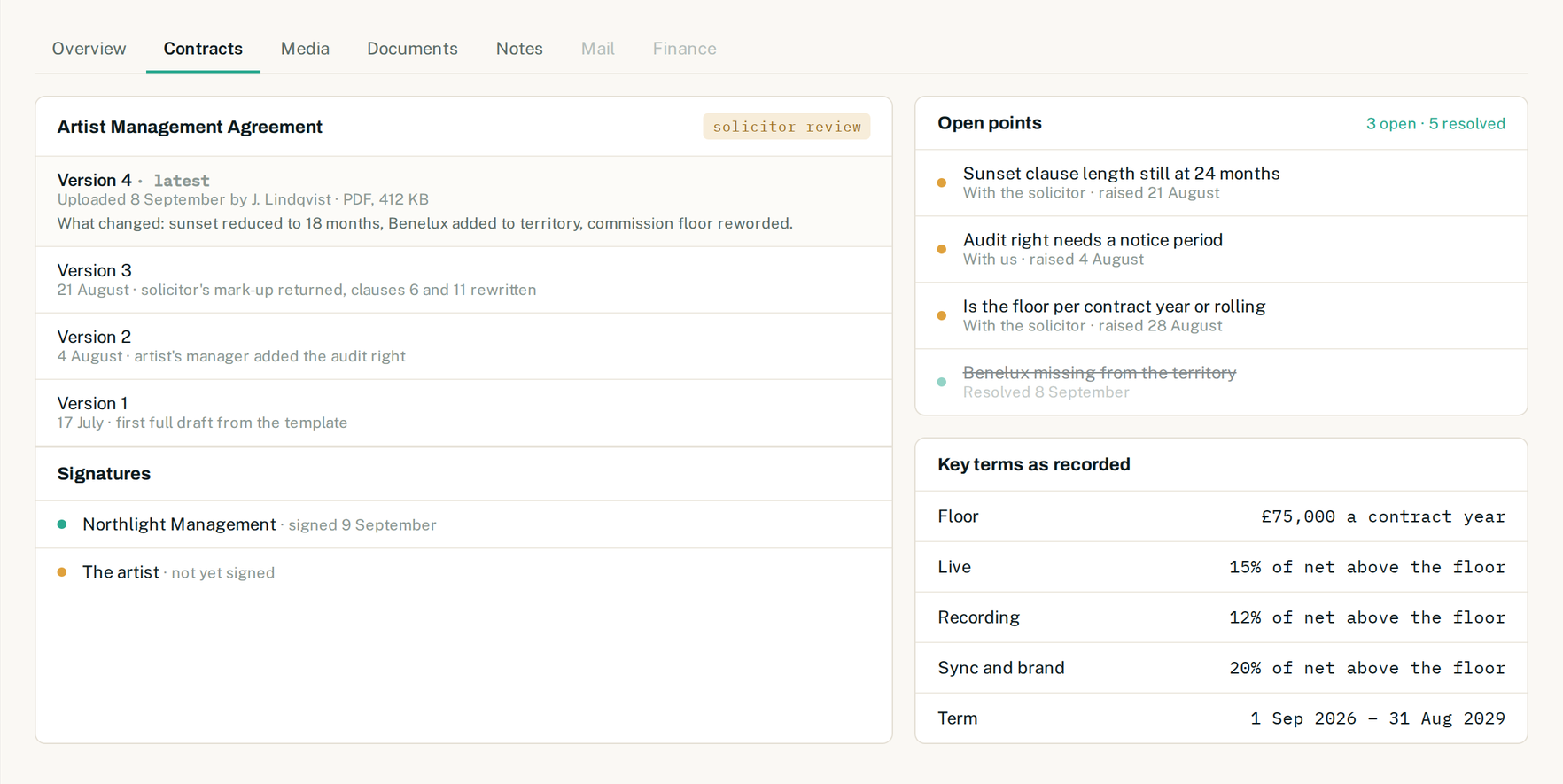
An open point is anything blocking a signature, and it carries who it is sitting with. It appears on every team member's Today page until somebody clears it, and clearing one folds it away without deleting it.
A year later you can still read what was argued about on an agreement and how it landed, which is the part that normally lives in one person's memory.
- Sunset clause length still at 24 monthsManagement Agreement v4, with the solicitor since 21 August
- Territory wording excludes Benelux by accidentManagement Agreement v2, with us
- Floor is stated per calendar year, should be contract yearManagement Agreement v3, with the artist
- Benelux added to the territoryResolved 8 September, folded away but kept
Eight pages, and one rule behind them.
The diary is open to everybody. Money and contracts are not.
What needs somebody
Counts, open points, contracts in progress, what arrived overnight, and who did what.
The roster, and the way to it
Four stages from prospect to archived, with the paper tracked separately from the relationship.
Versions and open points
One entry per agreement, every version under it, signatures per party, and what is blocking signature.
Audio, video, artwork, links
Plays in the page, collected across the roster, with a send-in link so anybody can post files in.
Everything that is not an agreement
Identity, tax, riders, press, artwork and correspondence, with a restricted tick for the sensitive ones.
The whole roster's diary
Booked and unbooked, month by month or six months at a glance, with clashes flagged in red.
Floors, commission, pipeline
One set of figures behind all three, per artist and across the roster, by contract year.
Roles and an activity log
Four roles, set by an admin, and a line for every action with a name and a time against it.
Mail and signature
Not built yet. The places they will appear are marked in the interface rather than promised on a page.
One list holds the roster and everybody on the way to it.
The stage tracks the relationship. A separate column tracks the paper, because the two move at different speeds. An artist can be in development with an agreement already at the solicitor, or signed with a second agreement still drafting.
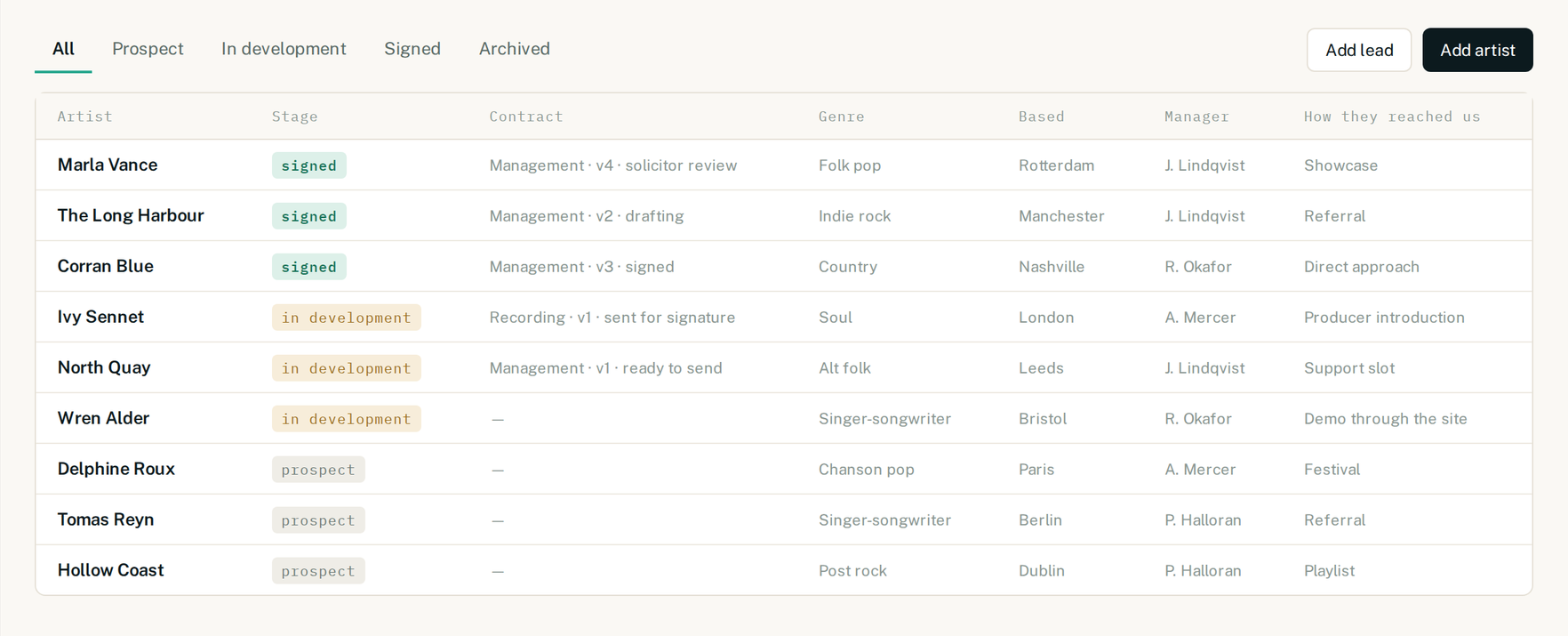
- Leads is the same list filtered to prospects, and sits separately because working a lead list is a different job
- Every record carries how they reached you, so after a year you know which showcases and referrals are worth the evenings
- Whoever adds an artist becomes their manager by default, changed in one field on the record
- Archiving hides an artist and keeps everything. Deleting is admin only, takes every file with it, and cannot be undone
Every version, and the points still blocking signature.
One entry per agreement, with each version carrying a line saying what changed. In six months that line is the only thing that will tell you why version four exists.
| Status | What it means |
|---|---|
| Drafting | Being written. |
| Solicitor review | With a lawyer. |
| Ready to send | Approved internally, not yet out. |
| Sent for signature | With the other side. |
| Signed | Both parties have signed. |
| Expired | Lapsed or superseded. |
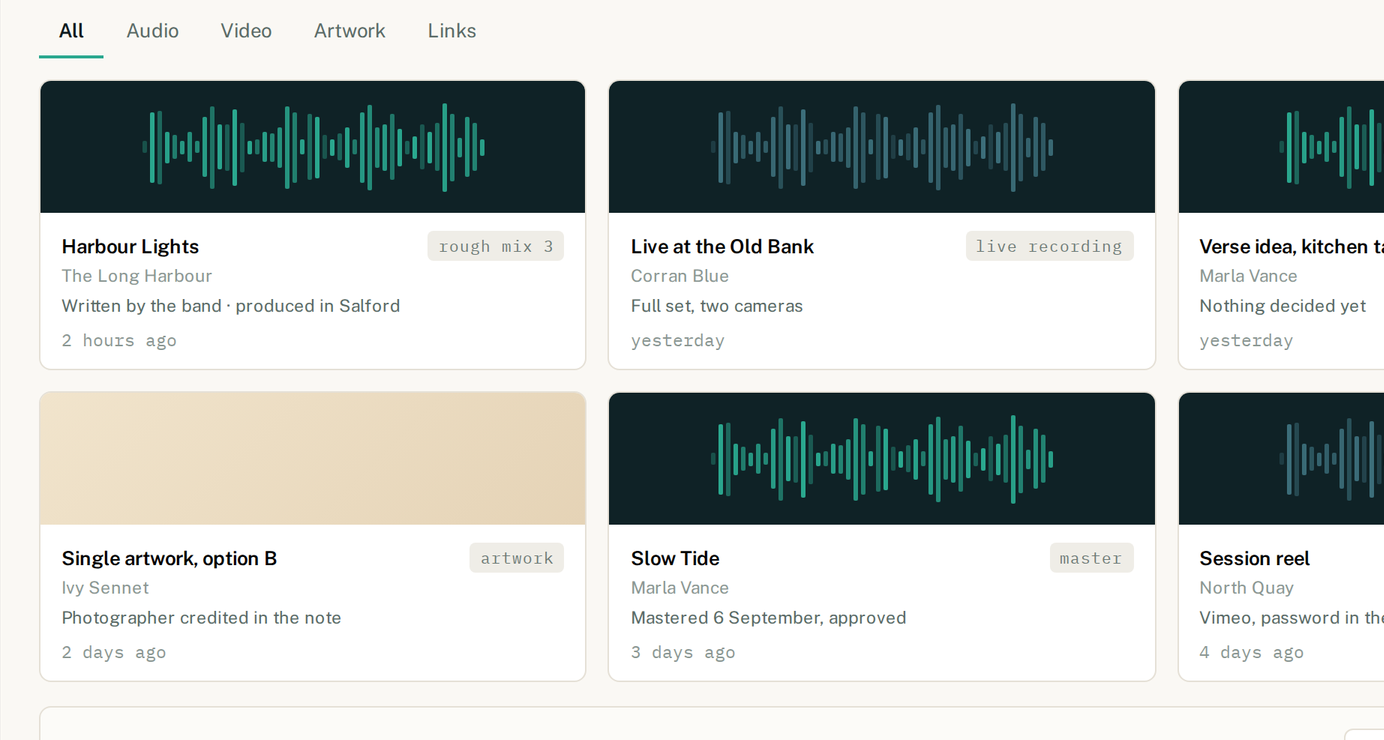
A letterbox for everything people send you.
Audio, video, artwork and links, on each artist and collected across the roster newest first, so a song sent in on a Sunday is not buried inside one record. Files play in the page and can be skipped through, which matters when you are checking one line of a mix in a forty minute session file.
No account, no sign in, one artist
A private address per artist that anybody can use to put files straight onto that record. Audio, video and artwork land on the media tab, documents on the documents tab, each carrying the sender's name and note.
It accepts files and does nothing else
Somebody holding the link cannot see the roster, the contracts, the figures, or anything already on that artist's record. Replace it and the old one stops at once. There is a ceiling of forty files an hour, so a leaked address cannot be used to fill the server.
A date you have not won yet still belongs in the diary.
Because it still stops you selling the same night twice. Held and everything after it counts as firm, everything before it is soft, and both sit in the same view.
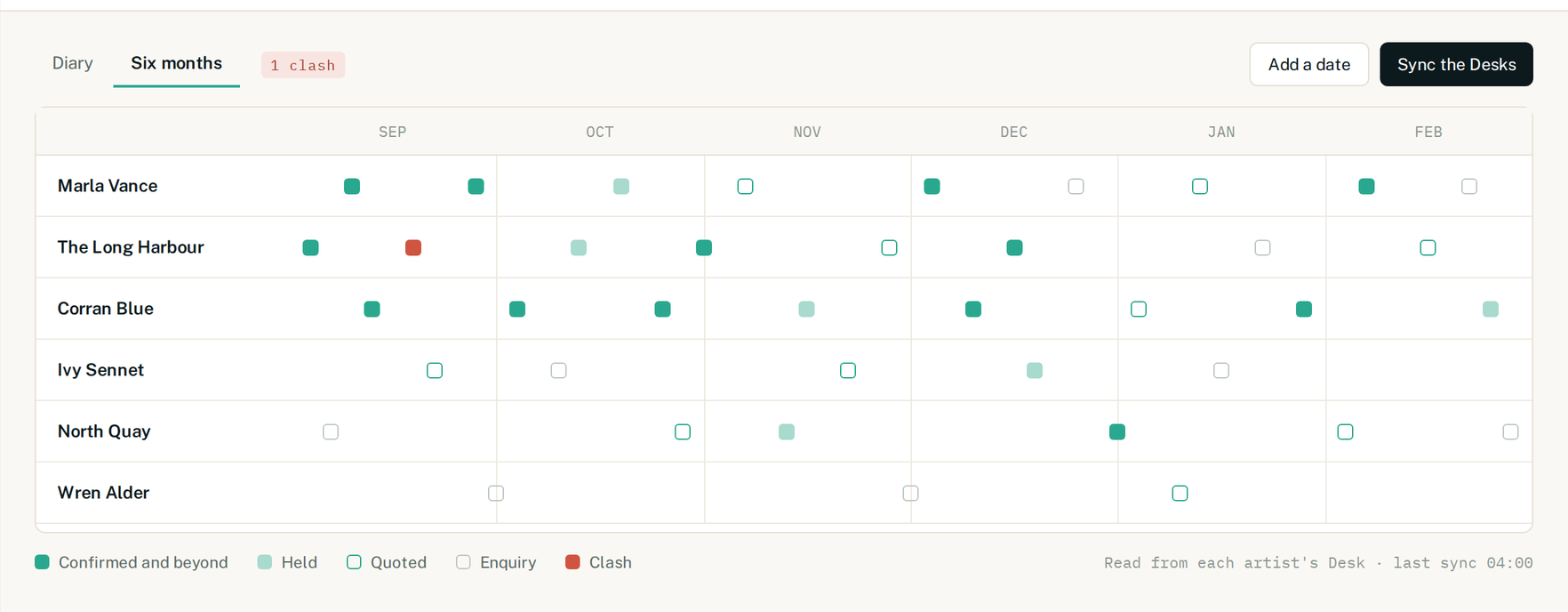
- Two dates for one artist on the same day, with at least one firm, are flagged red on both views and counted at the top. It does not stop you, since a matinee and an evening are both real. It stops you finding out in March
- Sessions, releases, press, travel, rehearsals, meetings and days an artist is not available all live here too
- Dates typed in by hand are never touched by a sync
What each artist has actually earned, against the floor.
Most management agreements carry an annual floor below which no commission is charged. The Booth reads the floor as a running total through the contract year, then charges every pound above it at that stream's own rate.
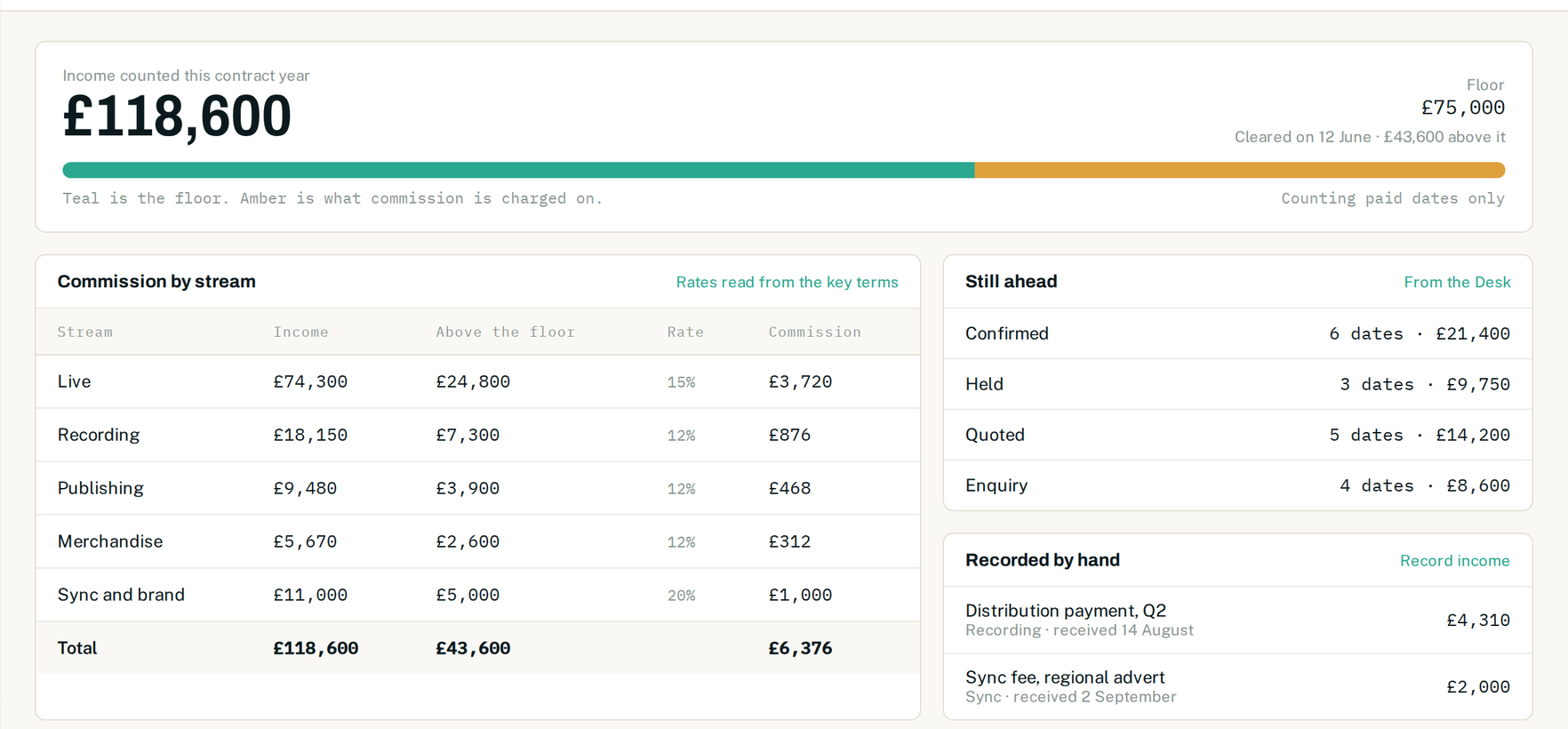
- Contract years run from the term start date on the artist's key terms, not from January
- A date becomes income when it is paid. A switch counts invoiced as well, for the picture including money that is out but not in
- Distribution payments, sync fees, merchandise settlements and brand deals are recorded here, because no booking system sees them
- With no artist selected you get the same picture for the whole roster, one row each
- Figures are net of VAT. Where an artist has a booking agent, that agent's commission sits outside these numbers
Four roles, and nothing shown with a padlock on it.
An admin sets a role and can change it at any time. Where a role cannot see something it is not shown at all. Research has no finance page in the rail, and fees are absent from that view of the diary rather than blanked out.
| Role | Sees and does | Money | Contracts and restricted files |
|---|---|---|---|
| Admin | Everything. The only role that can add or remove people, change roles, reset passwords, connect a diary feed, and delete what somebody else created. | Yes | Yes |
| Artist manager | Everything to do with running an artist: the record, key terms, contracts and versions, signatures, open points, media, documents, the diary and the figures. | Yes | Yes |
| Commercial | Artists and leads, media, documents, the diary including fees, the finance pages, and send-in links. | Yes | No |
| Research | Artists and leads, media, documents, the diary, notes and open points. | No | No |
It reads each artist's Desk. It never writes back.
Where an artist runs their own bookings in The Desk, their dates and fees appear here without anybody typing them twice. The connection runs one way, so The Booth cannot create a booking, change a fee or move a stage. If a fee is wrong here it is wrong on the Desk, and that is where it is fixed.
A read only feed goes on the artist's site
One file in their Desk folder. It reads the bookings and hands out a list. It loads none of the Desk's own code, so it cannot affect anything the Desk does for the artist.
A key is set at both ends
Without a matching key the feed refuses to answer.
Sync
One button reads every connected artist and reports how many dates it read and how many rows it could not make sense of.
Then leave it running
A scheduled task repeats it once or twice a day. A panel shows each artist, when they were last read and what the last result was.
The four answers that are no.
Worth knowing before a demonstration rather than after one.
Neither is built yet
The places they will appear are marked in the interface. Today you send from your own mail client and record the signatures as they come back.
It is not accounting software
It tells you what has been earned and what commission is due on it. Your accountant still does the accounts, and it does no royalty splitting.
No artist ever sees it
Artists get The Desk for their own bookings and The Diary on their phone. The Booth is the company's side of the wall.
Nothing is shared or pooled
One installation, one company. There is no shared list of artists, leads or figures, and no cross company reporting.
Per company, priced on the roster, not on seats.
A management company should not be charged for letting its assistant see the diary. What it costs depends on how many artists are on the roster and where the data has to live, so we would rather talk than publish a number that turns out to be wrong for you.
- One installation per company, on hosting we run for you or on your own server
- Your own domain and your own wordmark, so the team signs into your name
- Roles and permissions as standard, with restricted files for identity and tax papers
- Set-up and migration of the roster, contracts and current dates you already have, quoted once and separately
- Export everything in a readable format whenever you ask, without a conversation about it first
- A handbook written for the person who uses it every day, and someone to write to when something is wrong
See it with your own roster in it.
Half an hour. Bring one artist, one agreement and a month of dates, and you will be looking at your own material rather than ours. If it does not fit how you work, we will say so.